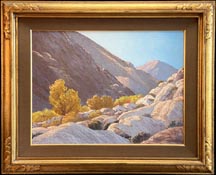
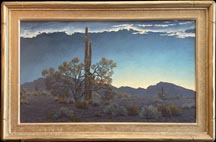
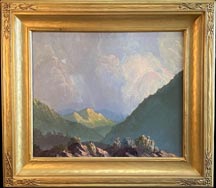
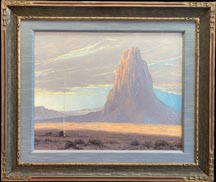
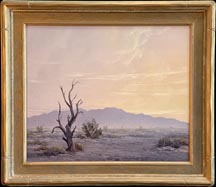
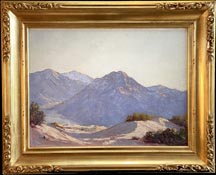
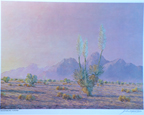
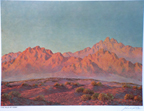
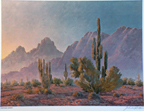
We also have 1 complete portfolio with all 12 of John W. Hiltons prints.
We are offering this at $900, ($75 / print)
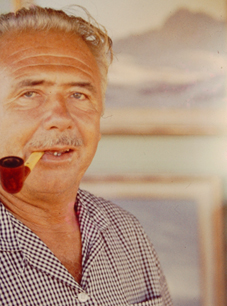
The life of John W. Hilton was extraordinary.
He was born in China, the son of missionaries, was raised as a pastor's kid in the American heartland, and then set his course in life on his own terms unencumbered by formal education.
Driven by a deep sense of curiosity, he became an expert gemologist, botanist, geologist and miner, zoologist, advisor to General George S. Patton, friend and fellow painter of General / President Eisenhower, enjoyed playing guitar and singing, a very good writer, and of course, he wasn't bad with a palette knife or paint brush either.
John W. Hilton made his home in the Mohave Desert, living near but never actually in Palm Springs. He preferred the desert. Early in his career, he ran an off-the-beaten-path gem shop and gallery across the road from his landlord Russell, who sold date shakes at his "Valerie Jean's" Date stand.
Part of the deal was John could run his gem shop as long as he didn't sell date shakes.
With a date shake in hand, desert travelers would stroll across the road and into John's gem shop. Some showed interest in a few of his displayed artworks, and some of the more artsy visitors helped advance John's painting talents.
Fred Chisnall was perhaps the teacher John appreciated most. John didn't think much of Fred's painting talents, but as a teacher and taskmaster, none was better. He was impressed that Fred had the gumption to get out and sell his paintings off the back of his pick up truck. A Who's Who of other artists stopped by too, such as Nikolai Fechin, Maynard Dixon, Clyde Forsythe, and Jimmy Swinnerton. They all contributed and influenced Hilton's fantastic ability to capture desert light, and formed life long friendships which included many painting excursions.
But John's life cannot be defined by his painting alone. He was a man of inquisitive adventure. (Read More)
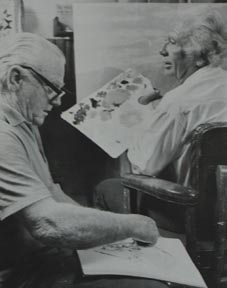
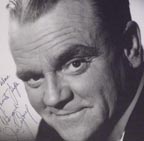
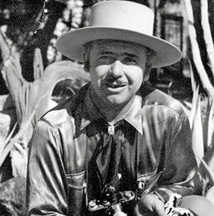
John W. Hilton with fellow artist
and close friend, James Cagney
previous articles of John W. Hilton from our Newsletter
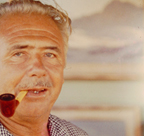
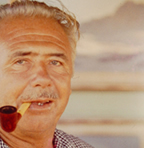
March, '17 John W. Hilton,
a man of the desert
and like minded friends
Upcoming, Jan , '23 New to me,
Scrapbook photos
of John W. Hilton
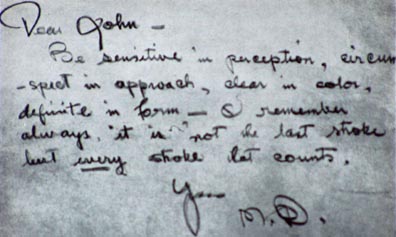
This note to John Hilton is from Maynard Dixon.
"Dear John, Be sensitive in perception, circumspect in approach,
clear in color, definite in form -- and remember always,
it is not the last stroke but every stroke that counts.
Yours, M.D." ( Painters of the Desert, Ed Ainsworth, 1960.)
Soon after Pearl Harbor, John noticed a few Army officers in a desert restaurant and introduced himself. After pleasantries were shared, the officers asked John's advice as to where to locate a training base for General Patton and his tanks. John circled what he thought to be an appropriate spot on the map and soon John found himself invited as a member of a reconnaissance mission into the desert with Patton himself.
On one trip into the nearby Arizona desert, the General chose a certain campsite near two sets of cottonwood trees. John told the General that sidwinders would be passing from one group of trees to the other during the night, but the General being the General stood his ground. Later that night, "old Blood and Guts" found himself drawing one of his pearl handled revolvers and shooting an unwelcomed sidewinder drawn by the light of their campfire
After Patton's Army went to North Africa, John missed his friend the General, but found his own way to help in the fight. He discovered and mined a super secret substance, a rare form of a common crystal called "optical" calcite, used in making highly accurate sights for the defensive guns on allied bombers. The sights sharpened the targeting accuracy of these guns used to shoot enemy fighters, and raised the survival rate of allied bombing patrol missions. Consequently, less missions had to be flown through hostile air space, saving airmen's lives. If John had been a better businessman, optical calcite, could have made him rich, but he believed himself part of the greater war effort, and refused to ask the army for more money.
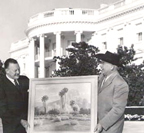
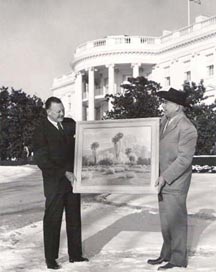
After the war, while John was showing his paintings in Palm Springs, General Eisenhower came by, touched one of the paintings and left a fingerprint. Ike apologized, but John was most forgiving, commenting that the General's fingerprint raised the price of the painting. Ike painted with Hilton on several occasions, and invited John to his innauguration in January of 1953. John presented the President a painting, Twentynine Palms Oasis, and the new President proudly hung it in the Oval Office. Today the painting hangs resides at the Eisenhower Hospital in Palm Desert, California.
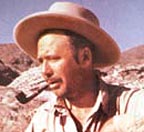
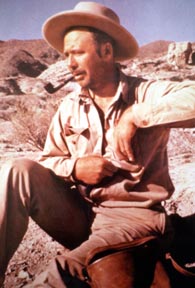
Taking a break at the
calcite mine during WW II.
There is much more to tell of Hilton - how he used to burn his less than impressive paintings on New Year's Eve in a revel with other eccentric desert dwellers, leaving bonfire ashes and empty tequila bottles on the desert floor. John believed one had to let go of his or her mediocrities in order to strive for greater work. He believed this was far better than making unrealizable New Year's resolutions.
John held a special love for the Mexican Sonoran Desert and a magical old Spanish town called Alamos where John and his family purchased a summer home. In the surrounding valleys and mountains, he collected rare and often uncatalogued plant and animal species for northern universities.
Can you imagine the steady hands of this gifted painter riding a horse, reins in one hand while carrying a newly captured gila monster in the other? That tale, along with other observations and stories are told in John's skilled writing style, sophisticated composition with with simple and plain spoken strokes, much like his paintings. Sonora Sketchbook is a great read.
John presents
Twentynine Palms Oasis
for Ike's Oval Office, Jan 1957
From John W. Hilton's album, Hilton Sings, his song Stake Me a Claim, written in honor of all prospectors, but sung by John at the graveside of his friend, Death Valley Scotty. Photos in this video includes the album cover artwork by John, a photo of Death Valley Scotty, the portrait of Death Valley Scotty by John Hilton's friend,
Orpha Klinker, a photo of Orpha Klinker,
and a photo of Scotty's Castle.
And John's creative output wasn't limited to painting or writing. He also played a little guitar and liked to sing. He made a record album with his baritone voice booming out ballads, Mexican folk tunes, and Indian chants. He even sang a tune at the funeral of a friend, Death Valley Scotty, which can be found on John's record album or by clicking the album cover to the left.
Death Valley was one of John's favorite spots and the locale of some of his paintings. One of these paintings resides behind the visitor's desk of the Death Valley Visitor's Center in Furnace Creek, alongside a painting by his daughter, Kathi Hilton.
Unpublished in any of the books or magazine articles by or about Hilton is a story shared by Kathi Hilton. Famed aviator and industrialist Howard Hughes was a friend of John, and flew in to see him, landing his plane on the highway in front of Hilton's gem shop.
On one occasion, Hughes brought fresh Maine lobster, providing it for little Kathi's birthday party. To this day, lobster remains one of Kathi's favorite dishes.
Hilton bent but never really abandoned his parent's hope for him to follow in their footsteps to become a missionary. The cover art on John's record album is a desert mountain painting entitled, "The Power and the Glory." On the back of his record album, he quotes his father who said of one of John's paintings, "Son, that is a sermon in paint."
Sources: Discussions with John W. Hilton's daughter, artist Kathi Hilton. The Man Who Captured Sunshine, by Katherine Ainsworth, 1978; Sonora Sketch Book, by John W. Hilton, 1947; Hilton Sings, Record album released under his own label; Photos, from The Man Who Captured Sunshine, by Katherine Ainsworth and cover art for John Hilton's record album, Hilton Sings.